
【Japanese Horror】The Hundred Horror Tales — Episode 23: After the Welcoming Fire | Haunted Kaidan Tales
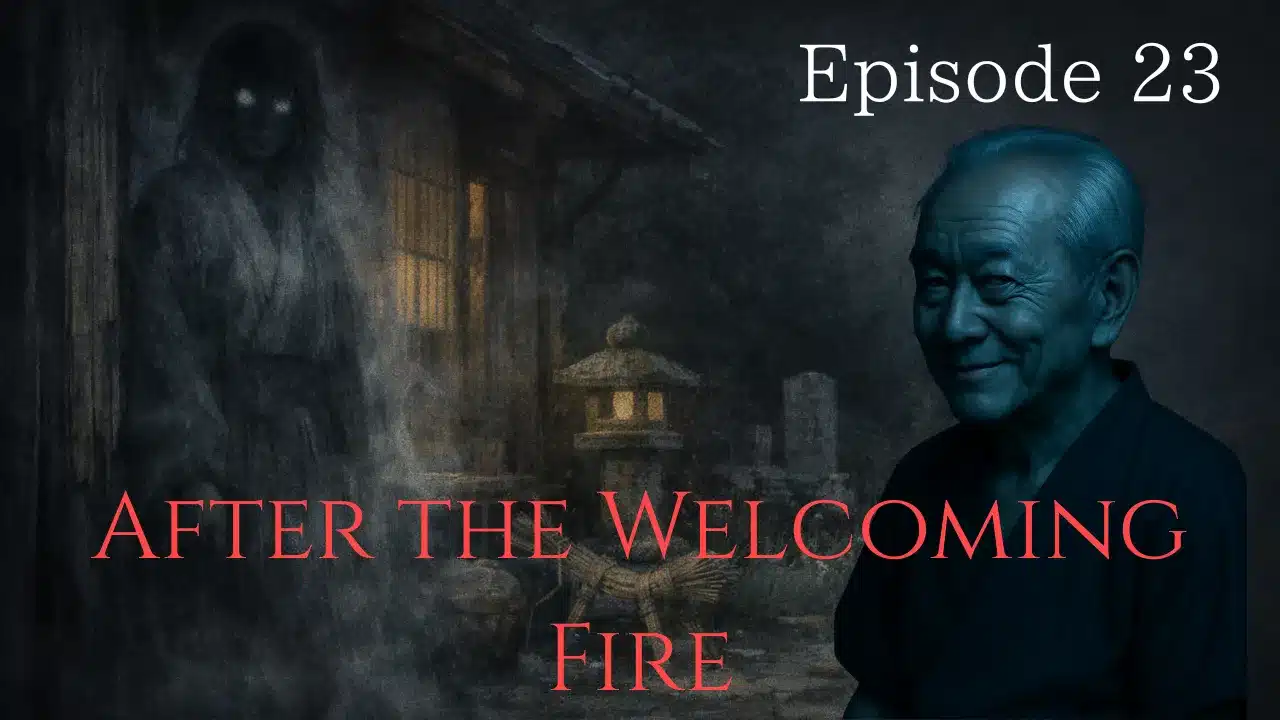
Listen to the Full Episode
Listen to the horror story with narration and sound on Spotify.
Episode 23 – “After the Welcoming Fire| Haunted Kaidan Tales” (Full Text)
Prefer reading? Here’s the complete text of Episode23.
Episode 23 – After the Welcoming Fire
Even after the candle’s flame went out,
the room did not fall silent at once.
It felt as though Aoi’s last breath still lingered in the air,
and no one dared disturb it.
Seikichi kept his eyes on the darkened wick for a long moment.
Then he shifted his gaze to the hearth fire and spoke quietly.
“…Sound. Breath.
Because they have no shape, they tend to remain.”
He was not speaking to anyone in particular.
“In the old days, people believed that tools used for many years would absorb a person’s presence.
Nothing grand enough to name.
Just something that settled there.”
Aoi’s hands tightened in her lap.
Sōma did not look away.
“Children’s things are lighter,” Seikichi continued.
“Their hearts move easily.
Their breath changes easily.
It is not that everything is taken…
but sometimes, a part remains.”
He paused.
“…Whenever I hear stories like that,
I think of the welcoming fire.”
The welcoming fire.
A small flame lit at the entrance of a house at the beginning of Obon.
“It is meant to guide those who return.
To show them the way home.”
The hearth snapped softly.
“But the people long ago understood something.”
He lifted his eyes.
“They knew that what returns
is not always only one’s ancestors.”
And then he began his story.
“When I was still a child…”
At the edge of the village stood a house that had long been empty.
Its sliding doors were warped.
Its garden had fallen wild.
No one would stay there.
The family line had ended generations before.
In the village it was known as a house with no lingering ties.
Then one year, a young couple moved in from the city.
They did not know much of the village’s customs,
but they were kind enough,
and caused no trouble.
As Obon approached, the couple asked their neighbors:
“Everyone lights a welcoming fire, don’t they?”
No one thought much of it.
“Well, yes.”
It was simply what one did.
A small fire before the house.
A light to welcome those who return.
But that house
had no one to welcome.
No ancestors rested in that soil.
No kin were tied to that land.
The couple did not know.
There was no reason they should have.
On the evening Obon began,
welcoming fires flickered throughout the village.
Smoke rose into the dusk.
Flames trembled in the wind.
At the house on the edge of the village,
a fire was lit as well.
There was only one difference.
That flame did not fade.
The wind rose.
The wood collapsed.
And still,
the small fire continued to burn.
Seikichi fell silent for a moment.
“A welcoming fire…” he said quietly.
“…does not always leave nothing behind.”
His eyes drifted briefly toward the extinguished candle.
The day after the welcoming fire,
the village did not suddenly grow restless.
Life continued as it always had.
At dawn, people went out to their fields.
At noon, they returned.
At dusk, doors were shut against the evening air.
The young couple from the city tried, little by little,
to settle into the rhythm of the village.
And yet—
there was a feeling that something was not quite the same.
It spread quietly, without shape.
The first to notice was the smell.
When passing the road at the edge of the village,
one would occasionally catch it.
It was not strong.
Not enough to make anyone stop and search for its source.
Just enough to make one think—
Has it always smelled like this?
A faint scent.
Earth, mixed with dampness.
Not like a field after rain.
Not like the riverbank either.
It was only around that house—
the one where the welcoming fire had burned—
that more people began to notice it.
Depending on the wind,
it would drift past for only a moment.
Sometimes, when you stepped closer,
it seemed to vanish entirely.
No one could clearly name what it was.
The couple sensed it too.
In the mornings,
when they opened the door,
the damp smell slipped in with the air.
“Did it rain yesterday?” one of them would murmur.
And yet neither could quite remember.
By midday, it faded.
By evening, it returned.
As though,
when the sun began to sink,
something deep beneath the ground
slowly started to seep upward.
Inside the house, the smell weakened.
But once outside again,
it clung faintly
to the hems of clothing,
to the soles of sandals.
Even after washing,
it did not fully disappear.
Some villagers frowned and said,
“…Perhaps it’s because someone’s living in that house now.”
No one spoke beyond that.
Without a clear reason,
it was better left untouched.
But at that time,
something in my chest would not settle.
Because that smell—
it did not feel like the smell of that house.
It was far too similar
to the smell of the cemetery.
On rainy days,
my grandfather once took me there.
The earth was wet.
The stones held their cold.
I did not understand why.
As a child,
I had no words for it.
But each time I passed near that house,
a small chill
would gather quietly
inside my chest.
One morning, just before heading out to the fields—
The husband slid open the door.
The moment it opened,
he stopped.
The smell they had noticed these past few days
was stronger.
Damp earth.
Soil and moisture mixed together.
It wasn’t a new scent.
It had been there before.
But now—
it felt closer.
“…It’s stronger today.”
He muttered it to himself
and looked down.
The ground in front of the entrance
had sunk slightly more than yesterday.
Not a clear footprint.
No heel. No toes.
Just—
a round depression in the soil,
like where a child might have stood.
He stared at it for a while.
Had it been there yesterday?
He tried to remember.
But nothing came clearly.
It felt as though
it might have always been there.
His wife stood in the doorway behind him,
breathing in the same air.
“It’s heavier,” she said quietly.
Her eyes followed his to the ground.
She, too, understood
she couldn’t quite call it a footprint.
They were already late for the fields.
Neither of them said more.
That evening, when they returned,
the smell remained.
Heavier than in the morning.
Only slightly—
but enough to notice.
The soil by the entrance
had settled further.
Not trampled flat.
Not exactly.
Just—
gradually smoothed,
as if pressed a little more each day.
The wife noticed something else.
On the wooden pillar by the door,
a faint mark remained.
Mud—
as though something had brushed against it.
Was it a handprint?
Not exactly.
No clear fingers.
No clear shape.
Only—
the kind of position
where someone might have placed a hand.
“…Was this here yesterday?”
The husband tilted his head.
When he wiped it with a cloth,
the mark vanished easily.
As if nothing had ever been there.
But the next morning—
the same faint stain
had returned
to the same place.
This time,
they clearly remembered wiping it.
And yet,
it was back.
The smell hadn’t faded either.
It wasn’t morning dew.
It wasn’t field soil.
It was damp—
and heavy.
The wife spoke in a small voice.
“…It feels like this house
is being used.”
She didn’t say by whom.
She didn’t say how.
Because the moment she did,
it might become real.
The husband didn’t deny it.
The door had been closed.
Locked—
by their own hands.
And yet,
every morning,
the soil at the entrance sank.
Every morning,
the pillar bore the trace
of something touching it.
And the smell—
day by day—
became clearer.
As though
being there
was becoming natural.
They heard it purely by chance.
One afternoon,
near the village well,
several elders had gathered, talking quietly.
The couple only happened to pass by.
They had no business there.
No intention of joining the conversation.
“…Lately,”
one of the old men said,
“hasn’t the smell of soil been stronger
out by the edge of the village?”
The husband’s step
paused—
just for a moment.
“It lingers,” another said.
“Even when it hasn’t rained.”
“Like earth that’s been turned over.”
They weren’t speaking to anyone in particular.
Just words drifting into the afternoon air.
The couple exchanged a glance.
It felt
as though their house
was being described exactly.
“When that kind of smell comes,”
someone added, almost absently,
“it used to happen
after welcoming fires were lit.”
The air shifted—
only slightly,
but enough.
No one continued.
No one said the welcoming fire was wrong.
No one said it shouldn’t have been done.
And yet,
once the words were spoken,
the topic ended naturally.
The couple offered a brief greeting
and walked away.
On the road back,
as they neared the outskirts,
the smell grew stronger again.
Damp soil.
Heavy.
The same scent
as the cemetery after rain.
On the night they lit the welcoming fire—
what had they called?
To what
had they quietly signaled,
“You may return”?
They still
did not know.
After that, some time passed.
Little by little,
the smell weakened.
It did not vanish overnight.
There was no clear moment
when it was gone.
Just—
mornings when one might think,
“It’s not as strong today.”
And before long,
no one felt the need
to mention it anymore.
The soil at the entrance
no longer sank as deeply.
The mark on the pillar,
once wiped away,
did not return.
The couple stopped speaking of it.
If someone said,
“It’s settled now,”
that was enough.
The villagers, too,
let the matter drift away.
The welcoming fire.
The smell of soil.
Both quietly moved
outside the circle of conversation.
And yet—
whenever anyone passed that house,
their steps quickened.
If asked why,
no one could answer clearly.
I was a child then.
I never went near that house again.
It wasn’t exactly fear.
It was more—
“Better not to touch it.”
But now, looking back—
we did not avoid it
because we were afraid.
We avoided it
because its presence
had already become normal.
There was no longer
any need
to confirm whether
something was there.
And so—
Every year,
when the season comes,
people light welcoming fires.
They believe
they are greeting
what is meant to return.
But how many truly know
what they are welcoming?
Even if one intends
to guide only the familiar back—
once a path is shown,
other things
may follow.
Whether what comes
is good
or bad—
I cannot say.
But once something
has been welcomed,
given a place,
and grown accustomed to the house—
there is no longer
a reason
to drive it away.
That is all.
Saying this,
Seikichi leaned forward
and gently blew toward the candle.
—fuu.
The flame went out.
At that moment,
one of the eggplants placed as an offering
rolled softly across the floor.
As if to say—
“I’m here.”
The remaining candle flames
flickered faintly,
casting unsteady light
over the room.
Next Episode
New episode drops on Tuesday, March 10 .
📖 View All Episodes
Work in Progress
✍️ About & Follow
The Hundred Horror Tales is an original Japanese horror anthology inspired by the tradition of Hyaku Monogatari.
Five storytellers gather around flickering candles to share chilling tales—urban legends, ghost stories, folklore, daily fears, and real encounters.
Can you endure until the last flame goes out?
Follow for more:
• Twitter: @KaidanTales
• YouTube: @HK_Tales
If you felt something… or noticed something, we’d be grateful if you quietly left a comment below.
Click here to leave a comment!This story was brought to you by Haunted Kaidan Tales.
Welcome to a world of Japanese ghost stories and eerie folklore.
Feel free to explore more chilling tales at your own pace.
Some stories were meant to be forgotten—
and yet, they still whisper to those who listen…